

Cognitive Liberation
How Obedience Loses Moral Force When Private Doubt Becomes Shared Recognition

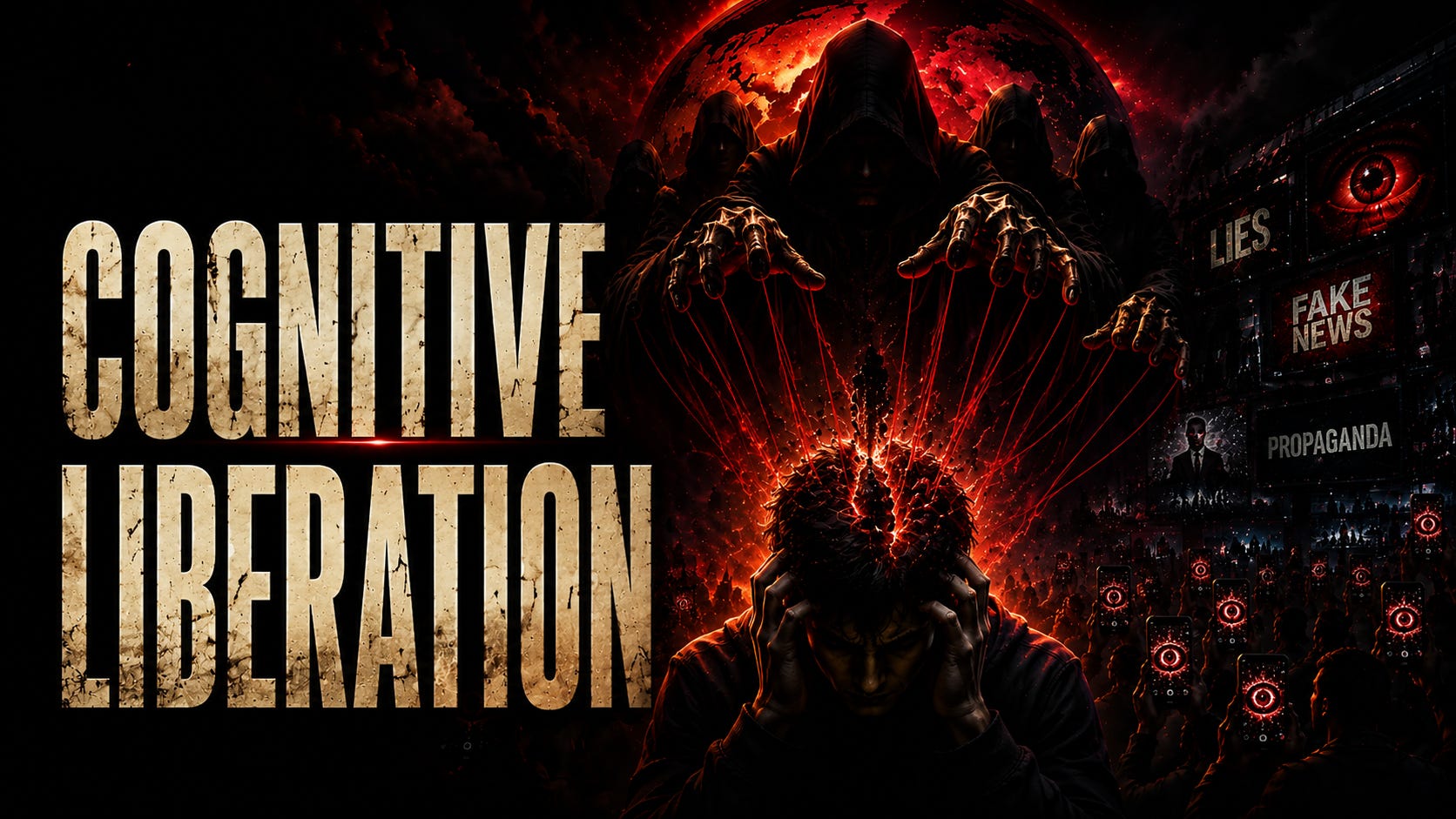
Legitimacy collapse begins with a simple fact about power: authority does not rule through force alone.
It rules by shaping what people believe is normal, safe, respectable, and inevitable.
A system can survive widespread private doubt as long as that doubt remains isolated. People may see corruption, contradiction, coercion, and failure, yet continue acting as if the system still deserves obedience.
They comply at work.
They repeat approved language in public.
They avoid certain topics with family.
They stay silent online.
They laugh at the joke that signals loyalty.
They lower their voice when they say what they actually think.
This is how false consensus is produced.
False consensus does not require everyone to believe the official story. It only requires enough people to behave as if they believe it.
Visible compliance then becomes evidence.
Each person looks around and sees others staying quiet, nodding along, following the script, and avoiding open dissent. The conclusion begins to feel normal.
Maybe I am alone.
Maybe speaking out is not worth the cost.
Power uses social psychology to exploit that uncertainty.
Most people are not obedient because they share the same beliefs, values, or vision. They obey because psychological pressure often acts before rational thought has room to form. The pressure of the group narrows what people feel able to question, say, or refuse.
They fear ridicule, isolation, embarrassment, and shame.
Compliance becomes a way to avoid social consequences.
People remain silent because they cannot gauge how many others privately recognize the same pattern.
Institutional authorities and corporate media do more than report events or relay information. They provide narrative cover: the story that makes authority appear reasonable, failure seem excusable, and coercion feel normal.
They also tell people how to interpret coercion, failure, corruption, and institutional betrayal.
They recast domination as freedom, surveillance as protection, austerity as responsibility, endless war as necessity, and obedience as virtue.
Narrative cover supplies the justification people need to accept conditions they would otherwise recognize as abusive, corrupt, or illegitimate.
When the story holds, authority keeps its moral standing.
Perceived legitimacy is the public belief that authority has the right to govern and deserves obedience. It means people still grant authority, patience, compliance, and control over public meaning, even after they can see its failures.
Once perceived legitimacy weakens, the same exercise of authority changes shape.
Before legitimacy collapses, obedience can still feel responsible, respectable, and safe.
After legitimacy collapses, obedience begins to look less like responsibility and more like complicity.
The act may be the same, but its meaning has changed.
That is the point at which authority faces a deeper problem than criticism.
It loses the power to define obedience as moral.
Individual awareness is when a person sees through the lie.
Shared recognition is when people realize others see through it too.
Common knowledge exists when recognition becomes mutually understood: people recognize the same truth and know that others recognize it as well.
Common knowledge turns recognition into coordination.
That shift changes how people judge risk, find courage, build trust, and act together.
This is the psychological rupture that threatens power.
Private doubt is easier to contain. It can be shamed, buried, distracted, isolated, or redirected into cynicism.
Shared recognition is harder to contain because it changes the social conditions everyone is responding to.
People begin testing whether their private recognition is reciprocated by others. They test which truths can be spoken openly. They notice who recoils, who quietly agrees, and who has been waiting for someone else to say something first.
The sense of isolation weakens.
Silence begins to carry a higher social and moral cost.
Fear begins to shift direction.
At first, people fear the cost of disobedience to authority.
After the threshold shifts, authority begins to fear public exposure.
Collapse remains contingent, not automatic.
Power can respond with repression, distraction, co-option, scapegoating, controlled opposition, and new narrative cover. It can split the public into camps, flood the environment with confusion, reward loyal interpreters, punish dissenters, and convert real anger into harmless spectacle.
Delegitimization creates the possibility of liberation.
The outcome depends on whether shared recognition becomes organized public power.
Cognitive Liberation names the deeper process underneath this shift.
It is the recovery of human judgment inside a system built to manage perception.
It means people regain the ability to judge reality without waiting for institutions to approve their judgment.
They begin to recognize manipulation while it is happening.
They stop outsourcing moral judgment to authorities that have forfeited trust.
They recover the language needed to name what is being done to them.
This liberation begins inside the person, but it cannot stop there.
Clarity alone is not enough. A person who sees clearly can still be isolated, exhausted, intimidated, or made to doubt their own judgment.
Power prefers awareness to remain private because private awareness does not yet threaten the system. It may produce frustration, but it does not automatically produce coordination.
The deeper threat begins when isolated perception becomes mutual recognition.
Cognitive Liberation becomes civic when private recognition moves through a public sequence.
Contradiction appears.
People notice the gap between official explanation and lived reality.
Private doubt forms.
People sense that something is wrong, but remain cautious.
False consensus holds.
Visible compliance makes each person feel more alone than they are.
People start comparing what they have noticed.
Private recognition becomes socially visible.
Shared judgment emerges.
People realize others see the same pattern.
Fear changes direction.
Dissent feels less isolating. Authority begins to look weaker.
Perceived legitimacy breaks.
The same authority that once appeared legitimate begins to look coercive.
Coordination becomes possible.
People move from scattered awareness into organized action.
Cognitive Liberation deepens.
People recover judgment, build trust, create public tools, and withdraw obedience from systems that survive by managing what people believe.
This is why truth is dangerous to power.
Truth does more than inform people.
It changes what people believe they are allowed to notice, say, reject, and organize around.
It breaks the spell of inevitability.
It weakens the pressure to perform belief.
It exposes the distance between official reality and lived reality.
Most importantly, it helps people see that their judgment is shared.
The shift from private awareness to shared recognition is the foundation of civic power.
It changes behavior because people judge risk through other people.
A person who believes they stand alone is more likely to stay silent.
Courage becomes easier when it is socially reinforced.
Trust becomes possible when people can see that recognition is shared.
Coordination becomes possible when people stop interpreting isolation as evidence that they are alone.
The deeper conflict is domination versus freedom.
Cognitive Liberation restores the human capacities that systems of domination work to weaken: conscience, courage, trust, memory, responsibility, language, and shared reality..
A population whose doubt remains private can still be governed through fear.
Once belief, silence, and obedience are withdrawn, authority must either rebuild legitimacy through truth and repair or expose itself through coercion.
That exposure is the fracture point.
Legitimacy collapses when obedience no longer feels like duty, safety, or necessity.
Cognitive Liberation is the act of people recovering the confidence to exercise collective judgment.
Empathic Revolutionary teaches people to recognize power for what it is — and never forget the human cost.
Empathic Revolutionary traces those mechanisms with moral clarity and psychological depth.
Empathic is the disciplined perception. It means taking seriously the emotions, suffering, dignity, and perspective of others as real forces that shape how people live, endure, obey, resist, and survive. People are never just voters, consumers, workers, data points, enemies, or objects to be managed. They are conscious moral beings under pressure.
A revolutionary refuses to treat harmful systems as permanent because they are familiar, legal, profitable, or socially approved. Revolt begins by seeing the machinery clearly: the incentives, institutions, stories, habits, and pressures that make domination feel normal.

We are in a time where the fight of facts is with your feelings — with your emotions, with the narratives that run alongside and inside them.
Narratives are suppressing nuances. Speed has become more important than verification. And in this environment, propaganda has extraordinary room to thrive.
What resonated with me is the distinction between private awareness and shared recognition.
I've learned that independent thinking isn't about rejecting every institution, expert, or authority figure. It's about being willing to examine what we're told, compare it with our lived experience, and arrive at our own conclusions.
As someone who works in a highly regulated scientific field and also explores spirituality, I've found that certainty can be just as limiting as blind obedience.
The challenge isn't simply seeing differently. It's remaining curious, discerning, and willing to question our own assumptions as well.
For me, cognitive liberation starts with taking responsibility for my own judgment.
Very thought provoking and enlightening. Thank you for sharing. 🌺