

Empathic Philosophy: First Principles of Civilizational Stability

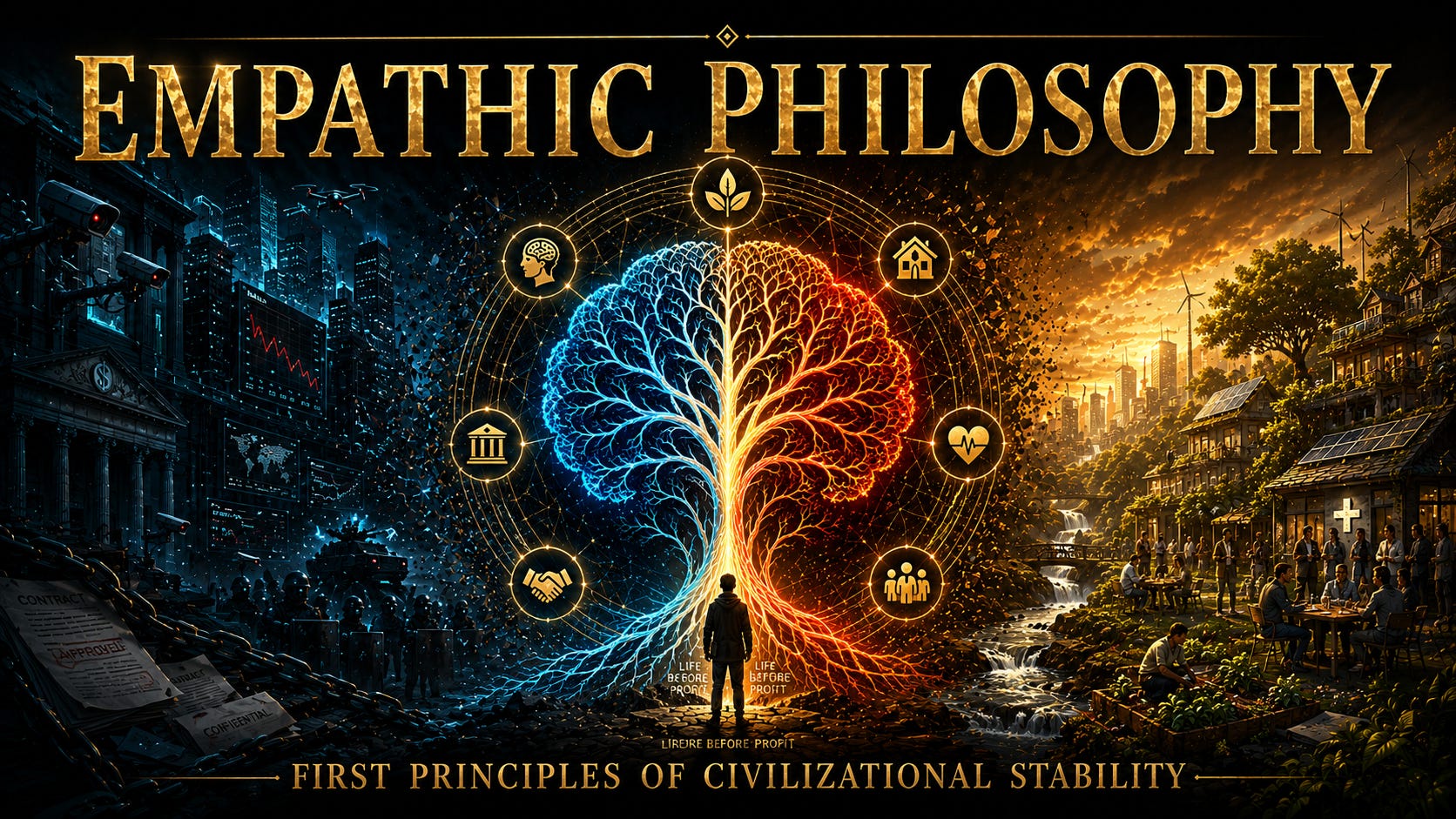
The same problem persists within Capitalist, Communist, and Anarchist ideologies — the concentration of Power.
Across history, philosophers have exposed the same truth over and over:
When power is concentrated without ethical restraint, progress becomes exploitation — and society loses its purpose. This deeply affects the human condition individually, collectively, and spiritually.
Whether in the fall of Athens, the collapse of Rome, or the revolutions of the modern era, the lesson is constant: no civilization can endure when its systems drift away from the well-being of the people.
And yet, throughout history, those who challenged the ruling order with new ideas were rarely welcomed. Philosophers have been ignored, mocked, exiled, and even killed for daring to question the foundations of power.
Socrates was sentenced to death for “corrupting the youth” of Athens by teaching them to think critically about their leaders. Confucius spent years in political exile after his calls for moral governance angered corrupt courts. Centuries later, the same fate awaited other thinkers — banishment, imprisonment, or worse — whenever they exposed the gap between a society’s ideals and its reality.
The lesson is both clear and damning: power resists any philosophy that threatens its grip — even when that philosophy could save the society that rejects it.
After more than two millennia of evidence, we still grant authority to politicians who protect their own position, rather than to philosophers whose empathy and insight reveal that the true wealth of any civilization is life itself.
Our ancestors survived the Ice Age not through wealth or power, but through cooperation, trust, and shared purpose — yet we have built a modern world that is no longer concerned with safeguarding the continuity of our species.
Society has created countless unnecessary rules and laws, yet none that protect a person’s right to exist. This reveals a profound failure at the core of governance.
This absence allows authority to operate without true accountability, making it possible for leaders, corporations, and institutions to destroy lives while remaining within the bounds of the law.
Modern government and economic systems are more concerned with profiting off society than protecting it — extracting value from the very people and resources they were meant to serve.
By prioritizing revenue, property, and control over the preservation of life, governance is reduced to managing transactions rather than ensuring human survival and well-being.
Without a foundation that safeguards our continued existence, every institution becomes inherently unstable, its success measured by short-term gain instead of long-term security.
The foundation of any enduring civilization must be the ability to sustain itself over a long period.
Therefore:
Every human being has the right to exist, to live free from systemic threats to their life, and to benefit from the conditions necessary for survival — clean air and water, a healthy environment, access to food, shelter, and healthcare.
The Basic Conditions
Life Before Profit
Human life must come before profit. No economy, institution, corporation, government, platform, or financial system has the right to sacrifice human beings for growth, efficiency, market value, political control, or institutional survival.
Survival Without Coercion
Every human being needs the basic conditions required to live: food, clean water, shelter, healthcare, safety, rest, and a livable environment. Survival should not depend on submission to abusive employers, predatory debt, political loyalty, corporate extraction, bureaucratic cruelty, or permanent insecurity.
When people must trade their dignity for the right to stay alive, survival has been turned into a control system.
Dignity Without Domination
Every person has a claim to dignity that exists before any government, market, party, employer, landlord, platform, or institution. People cannot be reduced to labor units, debt objects, data profiles, prisoners, consumers, targets, or props in someone else’s political theater.
Human beings are not resources to be managed by centralized power.
Thought Without Manipulation
Every person needs the freedom to think clearly and access truthful information. That means protection from propaganda, censorship, surveillance, algorithmic manipulation, emotional triggering, manufactured confusion, and weapons of mass distraction.
Power Made Visible
People have the right to know who holds power over their lives. They have the right to see who owns, funds, influences, governs, surveils, profits, censors, polices, frames, and decides.
Hidden power breaks public judgment.
Agency Over the Systems That Govern Life
People must have real agency over the systems that shape their daily existence. A person’s life is governed by more than elections. It is shaped by workplaces, banks, landlords, hospitals, schools, courts, police, media systems, platforms, supply chains, algorithms, and financial institutions.
Freedom to Coordinate
People have the right to find each other, speak openly, build shared judgment, organize, refuse abuse, and act together.
Isolation is one of the main weapons of centralized power.
These are not policy demands. They are civilizational demands. They name the conditions no government has the right to violate.
The First Law of Humanity names that promise as a binding standard in the social contract.
Political authority is legitimate only when the state protects the conditions people need to live with freedom and dignity.
Human behavior is not fixed — it is adaptive. We are shaped by the environments, incentives, and systems that surround us. When a society rewards exploitation, people learn to exploit. When it rewards the preservation of life, cooperation becomes the norm. The patterns of our behavior are not the result of unchangeable instincts, but of repeated reinforcement over generations.
Modern economic and political systems have conditioned us to value profit over people, to measure worth in accumulation rather than contribution, and to see competition as the default state of existence. This conditioning has distorted both individual and collective priorities, replacing our evolved survival traits — empathy, trust, and mutual aid — with transactional thinking and short-term self-interest.
The First Law of Humanity aims to reverse this distortion by realigning the foundation of society itself. If survival becomes the supreme standard, cooperation and empathy cease to be moral luxuries — they become the most rational and rewarding forms of behavior. This is not a surface reform. It is a psychological recalibration at the root of the dysfunction, where the measure of value shifts from profit to life itself.
Humanity is no longer bound by the limitations of environment or instinct. We have intelligence, foresight, and the tools to define our collective purpose — yet we have not chosen one. This is not a failure of knowledge or capacity, but a systemic avoidance of conscious, coordinated, species-level meaning.
Disagreement is inevitable in any intelligent species. A mature civilization does not suppress it with force, but channels it toward peaceful, constructive evolution. The universe is complex. The human condition is complex. Life is not about simplicity — it is about navigating complexity with precision, truth, and trust. Acknowledging nuance invites honest dialogue, replacing fear with understanding, and division with cooperation.

The Architecture of Political Freedom under Concentrated Power maps something already happening globally on social media.
People are watching events unfold in real time. They are comparing stories, sharing evidence, challenging official narratives, and realizing that millions of others are seeing the same contradictions.
That recognition is soft power. Social media is treated as distraction, outrage, or noise. And it is, but under the right conditions, culture can become a public nervous system.
The power is not in the platforms. The power is in conscious collective effort.
Great piece, great philosophy, thank you. If I may, I’m going to vent my thoughts and frustration. INFJs make up a small percentage of the population. Seventy years on this planet have taught me that the world can be a very lonely place, continuously waiting for others to catch up, engage, take action. People are better equipped to see the truth only once they themselves suffer in some way. If that is the starting point for some people, I fear we are too late.
The fact that we have fallen so far in 2026 is heartbreaking. I’m getting very tired. I don’t know how much longer I have on this earth. I will say, I’ll never stop trying to make this planet a better place for all of us. Any words of encouragement would be welcomed. I’m not feeling very optimistic these days. Thanks for listening.
A key hidden aspect of the BLACKSKINDIAN ORIGIANT's antediluvian paradigm is DEVOLUTION: the fact that the humans of today ALL Devolved from the BLACKSKINDIAN ORIGIANTs who first landed on this planet to settle it, farm it, fish it, hunt it, mine it, and build it, MEGALITHICALLY. 🙏🏾
Darwin's MYTHEORY nonsense was injected into our Superior MELANDIGENOUS paradigm (to handicap us) thru the neocolonial imposition of a fictional pedagogy that hides the true Cavern Origins and DEVOLUTION of NEANDERTALBINO's (misnomered white people) psychosomatic 'fall' down to their CURSED hairy & pale condition. 🤓