

Governing Without Consent
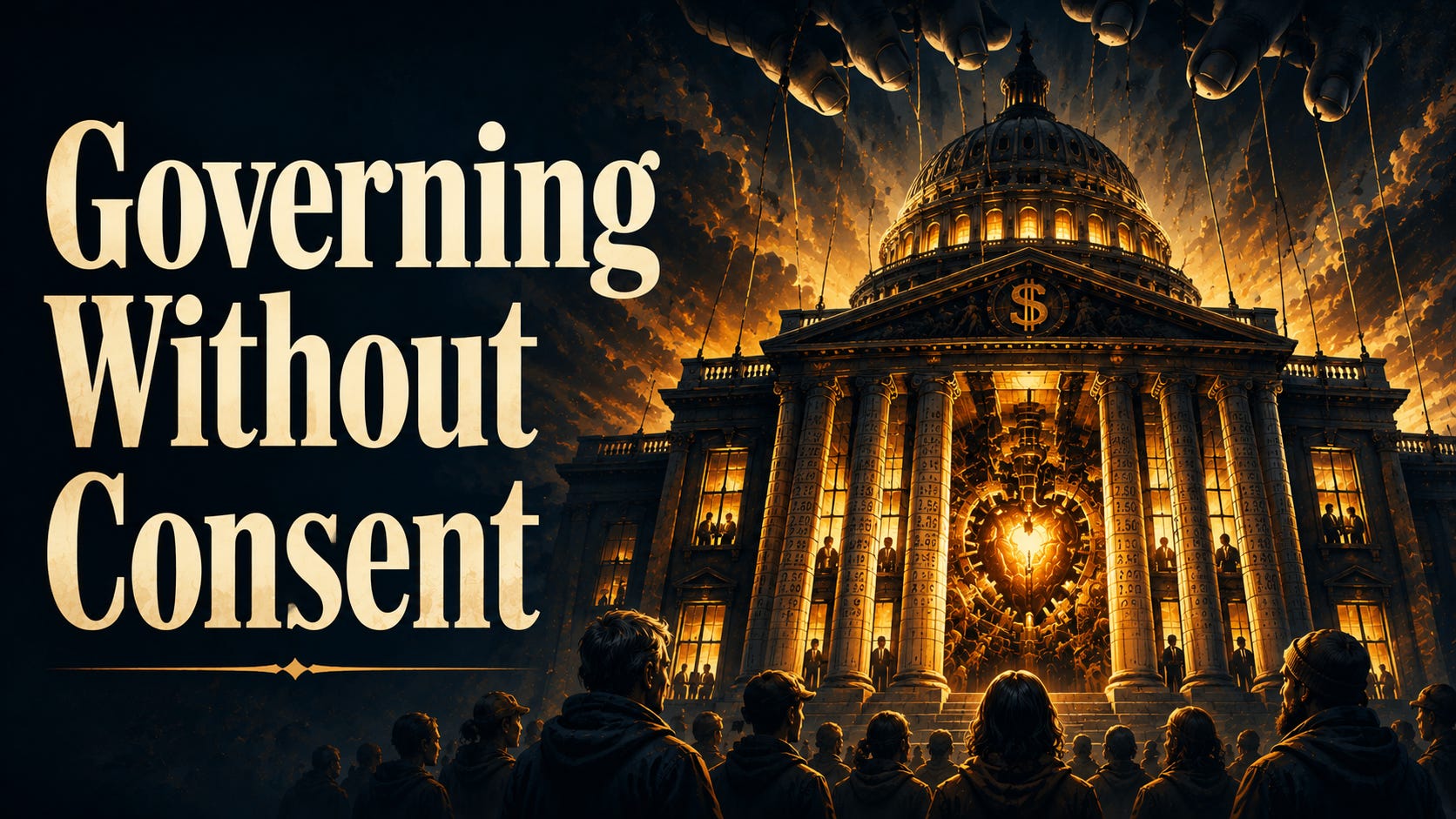
The founders promised self-governance. Americans got a system built on capital, elite immunity, and managed consent.

People are not objects to be managed, used, silenced, or controlled. They are conscious moral beings with perspective, agency, suffering, and freedom.
Any system that survives by suppressing that reality must be dismantled.
The founding promise was consent. What replaced it is a system where money shapes who runs, donor networks determine who survives, and institutions protect the powerful while extracting from everyone else.
This piece maps the mechanism: how lobbying displaced voting, how elite immunity became structural, how the culture war redirects public attention from the people who actually own the economy, and why distrust now crosses party lines.
The founding test still applies. The question is whether Americans will apply it.
America was founded on the radical ideal that ordinary people were not meant to be ruled by distant elites, permanent aristocracies, or institutions immune from accountability.
The government was supposed to rest on consent. When it became destructive of the rights it existed to protect, the people had the right to alter or abolish it.
What once felt like a promise now feels hollow to millions of Americans.
The crisis is the story of a system that has spent decades training people to believe their votes matter while allowing money, lobbying, foreign influence, corporate power, cultural manipulation, and protected elites to shape the actual outcomes.
The anger spreading across the country makes sense. People have watched the same pattern repeat for years: the public asks for change, politicians promise reform, and the machinery of power absorbs the pressure without surrendering control.
Two Systems of Justice
The Epstein files confirmed what many Americans already suspected: there is one system for working class people and a different system for those in the Capitalist class.
His 2008 plea deal was extraordinary. He received a punishment wildly out of proportion to the evidence against him. The agreement shielded co-conspirators, kept victims in the dark, and a federal judge later found it violated the Crime Victims’ Rights Act. The prosecutor who helped construct that deal, Alexander Acosta, later became U.S. Secretary of Labor before resigning after renewed scrutiny.
Then Epstein died in federal custody in 2019. The official finding was suicide. The circumstances were riddled with failures: guards who did not properly check on him, missing or unavailable footage, and competing forensic claims about the nature of his injuries. The public was asked to accept that one of the most connected criminals in the world died before trial, and that no deeper power structure needed to be investigated.
For many Americans, that was not believable. Not because every theory is true, but because the documented pattern is already damning enough. Powerful people maintained relationships with Epstein. Institutions failed to act. Institutions sealed, delayed, redacted, or obscured the evidence. And almost no one with influence faced meaningful consequences.
These revelations are at the heart of national distrust.
What the Founders Promised
The American founding was an extraordinary break from rule by kings, bloodlines, and inherited power. Its central claim was radical for its time: legitimate government does not come from status, wealth, religion, military force, or family rank. It comes from the people. Jefferson wrote that governments derive “their just powers from the consent of the governed,” and that when any government becomes destructive of the rights it was created to protect, “it is the right of the people to alter or to abolish it.”
The claim goes beyond elections. It says the people have the final authority to judge whether the system still protects the rights it was created to defend.
For generations, America showed that self-government could work. Its example inspired revolutions, democratic movements, and struggles against authoritarian rule around the world. But the America of 2026 increasingly looks like a country whose institutions have cut themselves off from the people they claim to serve.
Only about one-third of Americans believe the country is headed in the right direction. That number shows more than partisan frustration. It points to a deeper loss of trust in whether the system still has the right to govern.
Americans now see a country where healthcare costs too much, housing is out of reach, wages do not keep up with prices, gun violence is treated like normal life, foreign policy seems to answer to donors, and billionaires build fortunes so large that equality feels almost impossible.
They are not just being pessimistic. They are responding to visible evidence of institutional failure.
The collapse of culture is tied to the collapse of politics.
Culture Abandoned the Working Class
There was a time when American popular culture could confront the country honestly.
Marvin Gaye’s What’s Going On addressed war, poverty, police brutality, and the devastation of drugs in Black communities.
Bruce Springsteen wrote about working-class desperation. Don McLean’s “American Pie” turned national disillusionment into a massive popular song.
Films like Taxi Driver, Network, Chinatown, The Godfather, Dog Day Afternoon, and Apocalypse Now stared directly at corruption, violence, alienation, and institutional decay.
These were major parts of American culture, not small works made for niche audiences. The country once had entertainment that treated people like they could handle serious ideas. It could be entertaining and critical at the same time. It could be popular without being empty.
That time has passed. Now, the modern entertainment industry has become corporate product or political messaging presented as art. The result is a divided culture instead of a shared one.
Millions of Americans no longer see themselves in the institutions that create mainstream culture. They feel mocked, ignored, talked down to, or treated as problems that need to be corrected.
The internet moved into that vacuum: podcasts, independent media, streamers, alternative commentators, and political influencers. The field includes serious analysts, reckless performers, honest critics, and obvious grifters. Many succeeded because they recognized something legacy culture had stopped acknowledging: public anger was not simply ignorance or extremism.
It came from what people had lived through, from institutions that had betrayed them, and from a culture that no longer spoke to large parts of the country.
That kind of media environment does not build unity. It produces competing versions of reality. Each sustained by its own platforms, audiences, and incentives.
An Economy Built for Owners
Culture did not collapse in isolation. It collapsed alongside a massive concentration of wealth.
The top 1% of American households now control an extraordinary share of national wealth. Billionaires have grown richer at a pace that has little connection to how most people actually experience the economy.
The richest Americans hold trillions in assets while many families cannot absorb a medical emergency, rent increase, or grocery spikes.
The modern American economy has been designed to protect asset owners. When stocks rise, leaders often say the economy is strong. When billionaires grow richer, the overall numbers can look healthy. But those numbers do not show how wealth is actually divided.
They conceal the lived reality of people whose wages cannot keep up, whose debt grows, whose housing options shrink, and whose political leaders tell them the economy is working.
The tax code did not become this way by accident. It was shaped by decades of lobbying, campaign donations, regulatory capture, and legislative favors. The people with the most wealth helped shape the rules that govern how money is taxed, protected, and accumulated in America.
The public understands this even without knowing every number. Most people may not be able to cite campaign finance data, but they recognize the pattern in practice: the system responds quickly to corporations, donors, banks, defense contractors, pharmaceutical companies, and foreign-policy lobbies.
For everyone else, it moves slowly, selectively, or not at all.
Donors Replace Voters
AIPAC is one of the clearest examples of how political influence operates in Washington D.C.
The American Israel Public Affairs Committee and its affiliated political organizations spent enormous sums in recent election cycles to shape congressional races. Much of it is publicly documented.
The system does not always hide its corruption. In many cases, influence operates openly, through legal channels that still distort democratic representation.
When a single-issue lobbying network can spend tens of millions of dollars to defeat members of Congress who criticize Israeli military policy or call for a ceasefire in Gaza, the effect extends far beyond the politicians who lose.
Members of Congress watch what happens to their colleagues and adjust their behavior accordingly. Highly visible punishment raises the perceived cost of taking similar positions.
Over time, this creates anticipatory compliance: legislators soften their criticism, avoid certain topics, or remain silent altogether to reduce political risk.
The result is a chilling effect that narrows the range of views expressed within the institution. The message to the rest of Congress is unmistakable: challenge this agenda and you risk becoming the next political target, with your career put in the crosshairs.
This is how consent gets replaced.
Voters technically choose their representatives, but donor networks shape who can survive long enough to remain on the ballot. The public may hold one view on war, healthcare, taxation, or guns, while Congress delivers another because the incentives are aligned with funders, not citizens.
AIPAC is not simply one foreign-influence actor among many. Saudi Arabia, the UAE, Qatar, Turkey, China, and other governments all spend heavily to influence American policy through lobbying, think tanks, former officials, legal filings, media pressure, and informal networks.
But AIPAC occupies a different position because its influence is woven directly into the domestic political system itself: campaign money, institutional networks, media enforcement, access, and punishment for any dissent.
The Foreign Agents Registration Act is supposed to expose foreign influence to public scrutiny, but weak and inconsistent enforcement allows the most politically protected influence networks to operate with little to no accountability.
The result is a government whose foreign policy is shaped less by the interests of the American public than by the concentrated influence of well-funded donors and organized lobbying networks.
Institutional Betrayal
The United States spends more on healthcare than any other wealthy country, yet Americans often receive worse outcomes. Families pay staggering premiums, deductibles, co-pays, and out-of-pocket costs. Medical debt destroys lives. People ration medicine. Insurance companies deny care. Hospitals charge incomprehensible prices. Pharmaceutical companies protect profits through political power.
The system is designed to produce revenue, not health.
Public anger at the health insurance industry has become so intense because the system touches people at their most vulnerable moments. When violence reached the industry directly, the public reaction was disturbing because many people openly admitted that they understood the rage behind it. That reaction exposed a reality the Capitalist class prefers to avoid: millions of Americans see the healthcare system as an extractive institution that profits from their suffering.
An overwhelming majority of Americans have supported major healthcare reform in one form or another for decades. Yet meaningful reform repeatedly stalls because the healthcare industry devotes enormous resources to lobbying, campaign financing, and influence operations designed to shape policy outcomes.
The result is a healthcare policy process in which organized industry interests exert disproportionate influence over outcomes long before ordinary citizens have a meaningful opportunity to shape the debate or affect the final decision.
Remember when he said he’d “Drain the Swamp?”
Donald Trump understood the culture before much of the political establishment did. He called Washington a swamp and pointed to the lobbyists, donors, insiders, and career politicians who had captured the system. He promised to put America first, drain the swamp, reveal hidden truths, restore the working class, and govern for the people who had been ignored.
Many of his voters looked at the existing system and concluded, with evidence, that it had failed them. They chose the candidate who appeared willing to attack that system.
Trump did break from some ideas that both major parties had accepted for years. He challenged elements of China trade policy, questioned NATO assumptions, and disrupted foreign-policy consensus in ways the establishment hated. But the larger promises remained unfulfilled. Corporate tax cuts flowed heavily to companies and shareholders. Stock buybacks surged. The administration sold tariffs as protection for workers but they often functioned as higher costs for consumers.
The donor system remained intact. The revolving door between government and private power continued operating. The Epstein files were released only in heavily redacted form. The Justice Department maintained that it had found no evidence of a formal client list or organized blackmail operation.
For voters who expected a clean break from the old order, the result was another cycle of familiar disappointment.
Democrats failed to offer a credible alternative. Party leadership remained embedded in its own network of donors, consultants, cultural institutions, and foreign-policy commitments. The party had an opening to become a vehicle for structural reform, but it often operated as another manager of the same political order.
That is why distrust now cuts across party lines. Many Americans no longer see the problem as one party versus the other. They have lost trust in the political system itself.
Displacement
For decades, the culture war has consumed American politics. It began as a fight over religion, abortion, schools, sexuality, identity, patriotism, and national values. In the social media era, it became the primary content engine of politics.
Some of these questions reflect genuine conflicts over values, social norms, and the role of public institutions. A democratic society has to decide, through open debate, what its institutions should recognize, protect, promote, and transmit to future generations.
The problem is the scale of attention. Every hour absorbed by symbolic cultural battles is an hour not spent on housing, healthcare, wages, monopoly power, foreign influence, campaign finance, regulatory capture, or the tax code.
The culture war does not need to be centrally planned to serve powerful interests. It only needs to be amplified by media systems that profit from outrage.
When public attention is consumed by celebrity statements, school library controversies, coffee cups, online language rules, and symbolic gestures, structural questions receive less scrutiny: who finances Congress, who writes regulations, and who benefits from permanent dysfunction.
The culture war may emerge from genuine social conflicts, but it also operates as a mechanism of political displacement: public attention is redirected from material power, ownership, class rule, and institutional capture toward symbolic conflict that ultimately preserves the interests of the Capitalist class.
Breakdown
The American people were promised self-government. Instead, they live under a system where money carries more influence than votes.
Protected elites rarely face meaningful consequences. Institutions hide behind redactions, legal loopholes, and procedural delays to avoid accountability. Healthcare operates less like a public necessity than an organized extraction system. Foreign influence is normalized as routine politics.
Both parties demand loyalty from the public while remaining loyal to the donors, industries, and foreign interests that shape their power, even when that betrayal empties the country of everything it claims to stand for.
People recognize that the founding promise has been inverted. Americans are still told they govern themselves, but the system increasingly behaves as if real authority belongs to funders, lobbyists, corporations, intelligence agencies, foreign-policy networks, and billionaires.
That is why anger keeps growing: people are being asked to trust a system that keeps extracting from them, protecting itself, and refusing accountability.
Jefferson’s warning remains the constitutional test: when government becomes “destructive of these ends,” the people retain the authority to alter or abolish it.
Accountability is the political form of that authority. It requires institutions that disclose rather than conceal, parties that serve voters rather than funders, and public officials who fear public judgment more than donor retaliation.
America’s rage is a symptom of a deeper legitimacy crisis. The country can keep pretending this is ordinary partisan dysfunction, or confront it as a breakdown in consent.
The system will change. The only question is whether Americans will reclaim the authority to change it themselves, or whether that decision will be made for them too.
Empathic Revolutionary teaches people to recognize power for what it is — and never forget the human cost.
Power does not only operate through laws, police, money, media, or institutions. It operates through fear, dependency, legitimacy, narrative control, social pressure, emotional triggering, and managed consent. It shapes what people accept as normal, what they fear challenging, what they assume others believe, and what they can imagine changing.
Empathic Revolutionary traces those mechanisms with moral clarity and psychological depth.
Empathic is the disciplined perception. It means taking seriously the emotions, suffering, dignity, and perspective of others as real forces that shape how people live, endure, obey, resist, and survive. People are never just voters, consumers, workers, data points, enemies, or objects to be managed. They are conscious moral beings under pressure.
A revolutionary refuses to treat harmful systems as permanent because they are familiar, legal, profitable, or socially approved. Revolt begins by seeing the machinery clearly: the incentives, institutions, stories, habits, and pressures that make domination feel normal.

People are not objects to be managed, used, silenced, or controlled. They are conscious moral beings with perspective, agency, suffering, and freedom.
Any system that survives by suppressing that reality must be dismantled.
Continue reading:
The Architecture of Legitimacy Collapse — The full CKT framework: how private doubt becomes common knowledge through culture, and why visibility is the variable that decides whether a legitimacy crisis becomes collective force.
Propaganda Has Never Once Lied to You — Perception management operates through emotional targeting, not deception. That’s what makes it effective and what makes it hard to identify from inside it.
The Holy Deception of the State — Sacred language as political technology: how moral authority has been manufactured for a thousand years to make coercion feel like duty.
Democracy was always an illusion.
Freedom and liberty - hmmm! There is a massive difference - liberty is controlled freedom - you can do and think what you are allowed not what you want dictated to you through legislations, permits, licences, social pressures based on what is "allowed". I'll leave it there.