


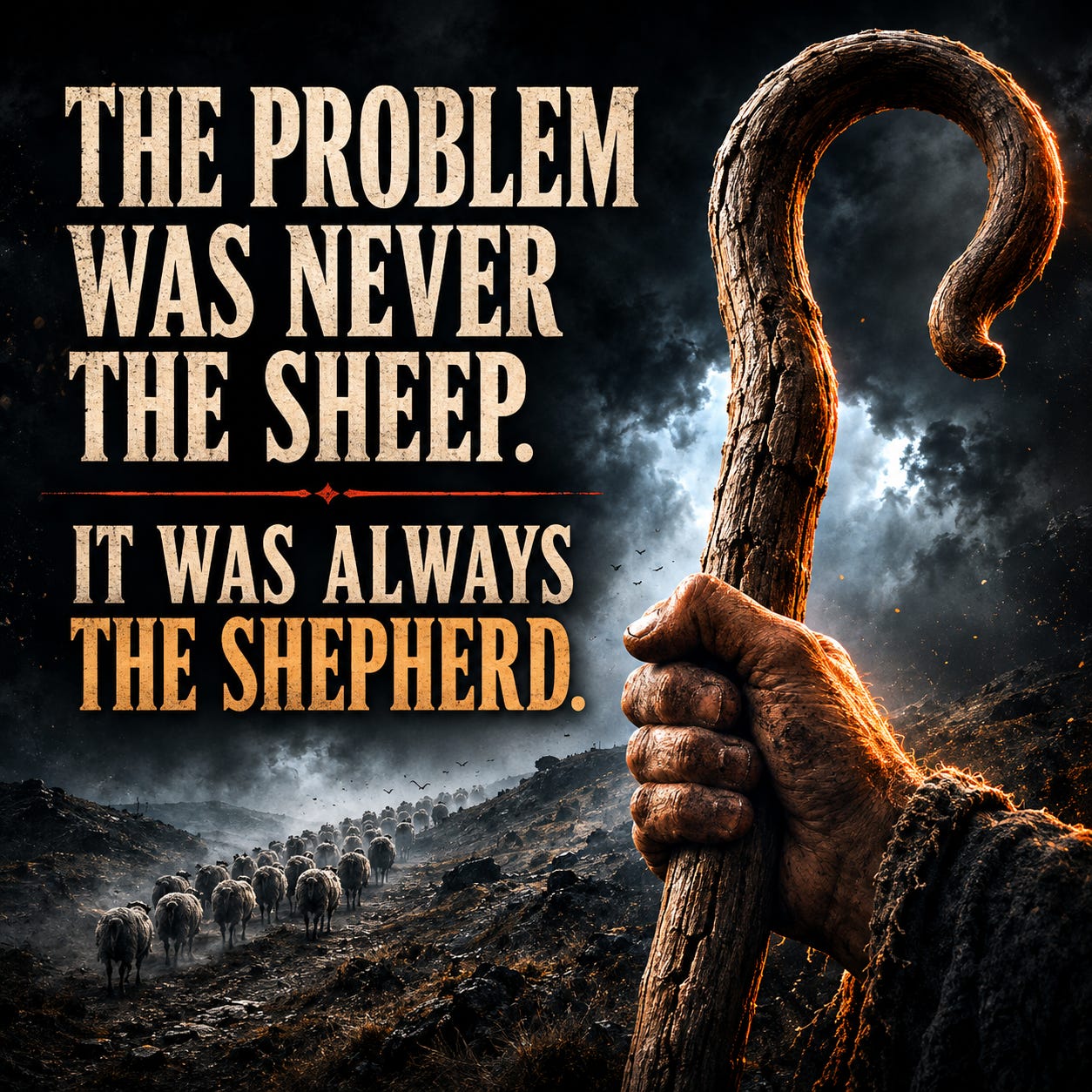
Place the same flock behind two different shepherds, and it can meet two entirely different fates. One leads it to pasture. The other leads it to slaughter. The flock’s tendency to follow remains the same. What changes is the hand holding the staff.
A common view of society reverses this relationship.
It sees two enemies: a predatory ruling class above and an obedient majority below. The people at the top design and profit from the system, while the masses defend it, enforce its norms, and turn against anyone who challenges it. From this perspective, the public is no longer merely governed. It becomes a second enemy.
The anger behind this view is understandable. Watching people defend institutions that exploit them can make contempt feel like clarity. But contempt obscures the structure of power. It confuses people who reproduce a system with those who possess the power to design, direct, and materially benefit from it.
It blames the flock for the destination while allowing the shepherd to disappear into the crowd.
The Object of Power
An enemy has its own strategy, interests, and command. A population is the terrain over which those forces struggle.
Governments, corporations, media systems, political organizations, and other institutions compete to shape what people believe, fear, tolerate, and demand. They study public behavior, construct narratives, reward compliance, punish deviation, and narrow the range of choices that appear realistic.
The masses can become instruments of domination. They can enforce social norms, repeat propaganda, isolate dissenters, and participate in cruelty. That makes them dangerous under certain conditions. It does not make them the architects of those conditions.
A weapon can cause harm without choosing where it is aimed. The public often possesses more agency than a weapon, but far less control than the institutions directing its attention, organizing its incentives, and defining the boundaries of acceptable behavior.
The distinction matters. Participation in a system is not the same as command over it.
Why People Follow
Human beings are social creatures. We learn from others, depend on groups for survival, and use the behavior of those around us to interpret situations we cannot fully understand alone.
These tendencies are neither virtuous nor corrupt. They are basic mechanisms of social coordination. Under decent leadership, they can support trust, solidarity, and collective care. Under predatory leadership, the same tendencies can be turned toward exclusion, obedience, and violence.
Most people do not independently investigate every claim, institution, or event shaping their lives. They rely on social cues, trusted authorities, familiar institutions, and the apparent consensus around them. In a complex society, no one can function without doing this to some degree.
Power exploits that dependence.
If every major institution repeats the same account of reality, dissent begins to feel irrational. If most people appear to comply, resistance begins to feel futile. If disagreement threatens a person’s livelihood or relationships, silence begins to feel necessary.
The system does not need everyone to believe. It only needs enough people to behave as though they do.
Conformity Is Enforced
What looks like mindless obedience is often a response to material and social pressure.
A public stand can cost someone a job, damage a marriage, fracture a family, or drive them out of a community. Institutions can deny opportunities, platforms, credentials, income, and access. Friends and neighbors can impose their own penalties through ridicule, suspicion, and exclusion.
These pressures do not eliminate personal responsibility, but they change the conditions under which choices are made.
For people with little security, resistance can carry immediate consequences while compliance appears relatively safe. The resulting conformity may be timid, misguided, or morally compromised. It is still intelligible. People respond to the incentives and dangers surrounding them.
A durable system of control does not rely on constant physical force. It makes obedience socially normal, materially convenient, and psychologically reassuring. It makes resistance isolating, costly, and uncertain.
Once those conditions are established, ordinary people begin enforcing them against one another. Vertical power reproduces itself through horizontal pressure.
Responsibility Follows Power
The metaphor of the flock has a limit. Human beings can question authority, refuse commands, protect one another, and organize against those who govern them. Followers are not incapable of choice, and participation in harm cannot always be excused as obedience.
But responsibility is not distributed equally.
It grows with knowledge, freedom of action, decision-making authority, and control over consequences. A person who designs a policy carries more responsibility than someone forced to live under it. A leader who manufactures fear carries more responsibility than someone who succumbs to it. An institution that makes dissent dangerous carries more responsibility than the person who remains silent to survive.
Those who knowingly help enforce an unjust system remain accountable for what they do. Yet their responsibility cannot be treated as equivalent to that of the people who created the system, command its institutions, profit from its operation, and possess the greatest power to change its direction.
The central moral distinction is between being caught inside an arrangement and having the power to determine how that arrangement works.
The shepherd carries the greater burden because the shepherd chooses the destination.
Contempt Protects the Shepherd
Blaming the masses does more than misidentify responsibility. It strengthens the people who actually hold power.
Contempt turns opposition downward. Instead of examining who controls institutions, shapes incentives, constructs public narratives, and benefits from collective obedience, critics exhaust themselves attacking the people subjected to those forces.
This posture can feel intellectually satisfying because it separates the dissenter from the crowd. The believer becomes one of the few who can see; everyone else becomes stupid, cowardly, or morally defective.
But superiority is politically sterile. A public treated with contempt cannot be understood, persuaded, or organized. The more completely critics come to hate ordinary people, the less capable they become of building power with them.
The shepherd benefits from this division. While the flock is divided against itself, the hand holding the staff escapes scrutiny.
That hand does not always belong to a single leader. It may belong to a ruling class, a network of institutions, or a system that distributes authority across governments, corporations, financial interests, media organizations, and administrative bodies. The shepherd is whoever possesses the power to set direction while remaining beyond meaningful public control.
Watch the Hand Holding the Staff
The same public can sustain radically different social orders.
People can be taught to fear one another or recognize their shared interests. They can be organized around domination or mutual obligation. Their dependence on others can be exploited to produce conformity, or developed into the trust required for collective action.
The decisive question is who shapes those conditions, for what purpose, and under whose authority.
Character matters, but no society should depend on the moral character of whoever happens to hold power. A benevolent shepherd can be replaced by a predatory one. The lasting answer is to build institutions that make power visible, accountable, challengeable, and removable.
Leadership should expand people’s capacity to judge and act for themselves. It should create capable equals rather than permanent followers. A legitimate social order does not merely hope that those holding the staff will use it well. It gives the people affected by their decisions the power to correct the course.
The problem was never some permanent defect within the public. The problem begins wherever power can direct human behavior without answering to the human beings whose lives it shapes.
Judge those who choose the destination. Examine the forces that keep the flock moving. Watch the hand holding the staff.
Then make certain that no hand can hold it beyond the reach of those being led.
Stop Treating the Herd as Dead Weight
A few people can expose the system. They cannot overthrow it. That requires the masses. Until a significant share of the population understands what is being done to them and can act together, revolution is nothing more than an idea.
Those with the awareness and critical judgment to see through the system have a responsibility to reach the masses, earn their trust, strengthen their courage, and guide them toward collective action.
The “sheeple” blamed for sustaining this system are the only force capable of creating the political will required to dismantle it.

The Empathic Revolutionary publication opposes any centralized authority sustained by domination, extraction, and the De-humanification of human existence.
Human beings do not exist to serve systems. Systems exist to serve human beings.
How to Support
Serious, independent thought requires time and material support.
Paid subscriptions sustain this publication’s research, writing, analysis, visual media, and community work—independent of advertisers, parties, donors, algorithms, and the news cycle. Help carry this work forward with 50% off your first year.
This argument is meant to be tested. Add your perspective, challenge the analysis, or identify what it leaves unresolved.
Collective understanding develops through serious discussion. Join the subscriber chat to examine these ideas with readers committed to thinking clearly about power and what it will take to transform society.

More from The Empathic Revolutionary
The Machinery of Compliance
How conformity shapes perception, authority disperses responsibility, and institutions turn harm into duty.
The Pyramid of Thought
Why most people remain trapped in repetition and reaction—and what it takes to develop independent judgment.
What an Empath Becomes When They Commit to Human Liberation
How empathy develops into disciplined perception, moral courage, and a commitment to collective liberation.
Good article. I’m often reminded of what R. Buckminster Fuller said: “People never leave a sinking ship until they see the lights of another ship approaching.”
Most people WILL shift their choices to something better WHEN something better is safe, secure and readily available enough, where they live, to choose to participate in. And it just so happens to be a way to build collective power.
I live in a city about 50,000 people. No tool library exists. Other cities in my country have them. They work, they have existed for 10+ years, in some cases. But my town doesn’t have one. So well-meaning people in my town have no place to donate their extra tools or to borrow tools, temporarily, except for lucky personal relationships they may have with neighbours and family who will allow them to borrow those things. That is nice, but it isn’t a solution or a pathway to a more balanced, sharing city of access abundance.
So, I’m working with a group to establish a pilot project tool library that hopefully grows into an official worker-owned non-profit building that is supported by the community – similar to the public library.
Until the tool library is a viable option, I can’t go around blaming my friends and family for throwing out perfectly good tools or trying to sell them at a garage sale or just store them in a shed, collecting dust. There is no better option for them right now.
My organization has started doing repair café events, which is a good start. Once we get more momentum and awareness, we can have more variety of repair café events. At that point I CAN offer my friends and family an option other than throwing out their slightly broken items, to consider donating their time or items to a repair café. And that is a great thing to do. But it has to be readily available or else blaming them for not being ‘more ethical’ is really a pointless endeavour.
If we build it properly, they will come gladly. (Not meant to sound dirty ;p)
Great Article! Yes do not view them with Contempt. They are "asleep" because they don't know what to do. There is an illusion of choice right now. Both roads end up at the same place. It is not that the politicians are unaware of the problems. They are very much aware they are choosing not to act.