
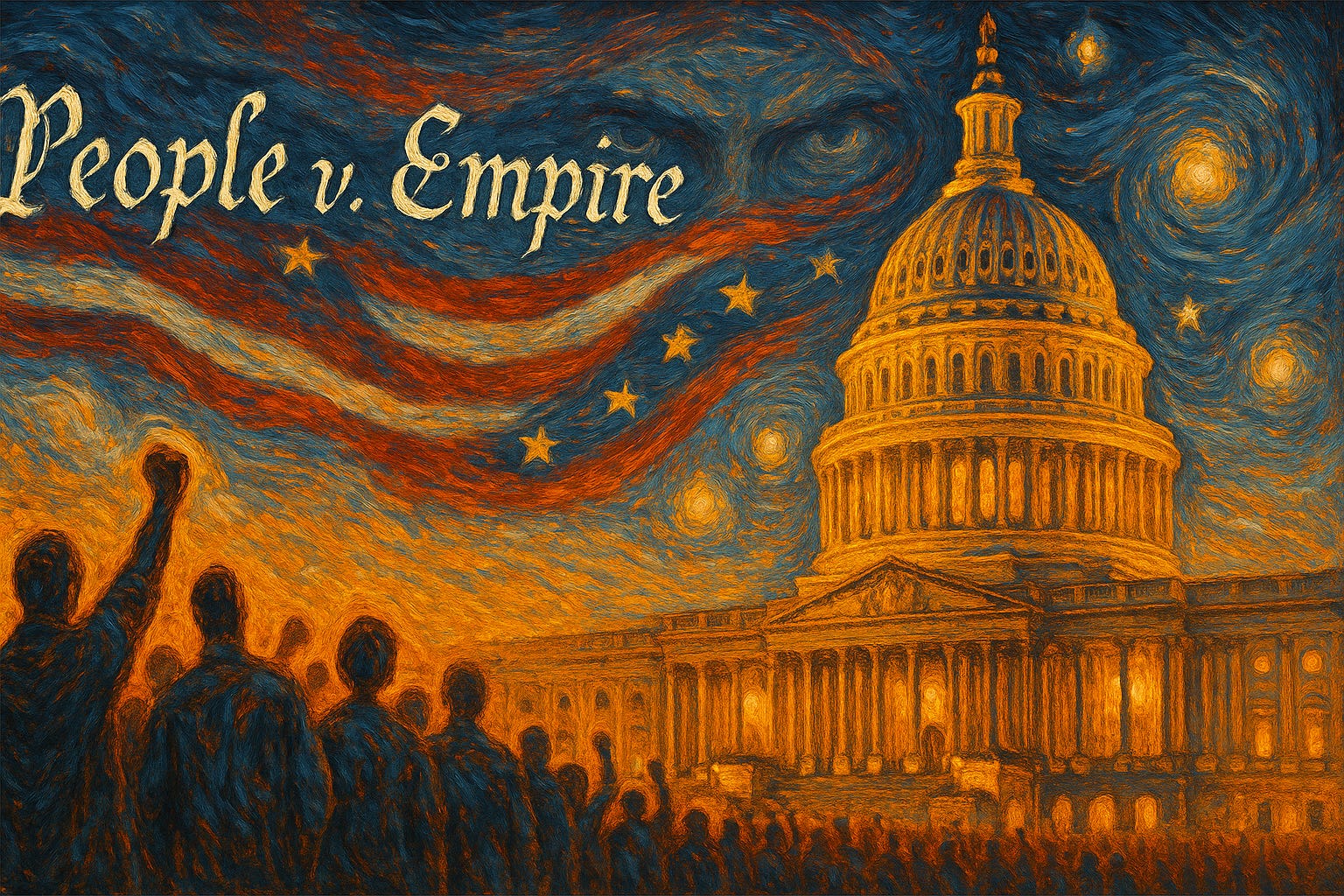
People v. Empire
Revolutionary Consciousness

The struggle of this era runs deeper than nations, ideologies, or social classes; it is a psychological struggle between a mind trained into authoritarian submission and system-justifying belief, and an emerging awareness that recognizes concentrated, unaccountable power and denies it any legitimacy.
People v. Empire
Revolutionary Consciousness
The defining conflict of our era runs deeper than nations, ideology, or even social classes. It is a psychological struggle between two states of mind: one conditioned into authoritarian submission and system-justifying beliefs, and another—still emerging—that sees concentrated, unaccountable power for what it is and refuses to grant it legitimacy.
The Empire operates as a global hierarchy of states, corporations, security, and financial systems—a hierarchy that normalizes some of humanity’s darkest traits: genocide, organized sexual abuse of children, psychopathic indifference to suffering, incestuous power circles, and eugenic fantasies, while conditioning populations into conformity, identity-bound obedience, and learned helplessness to keep itself intact.
This power architecture can only rule with our consent—or at least our resignation—so it invests enormous resources in training us to doubt ourselves, blame our neighbors, and rationalize away what we see.
Revolutionary Consciousness means cognitive liberation: interrupting automatic deference to authority, developing metacognition about how narratives are engineered, and rebuilding standards of legitimacy around the principle that certain rights should never be violated, no matter the supposed benefit to others.
The United Corporations of America
After World War II, governments faced wrecked economies, mass displacement, and the question of what rules would govern the next phase.
In the same mid-1940s window, two opposing blueprints took shape. Inside the new United Nations system, jurists, philosophers, and diplomats—including delegates from colonized and smaller states—treated law as a tool for drawing bright lines around the worst things states could do to human beings.
The Universal Declaration of Human Rights (UDHR) was not a treaty, but it set a universal floor: actions no government could excuse if it wished to call itself legitimate, including torture and cruel, inhuman, or degrading treatment; arbitrary arrest, detention, or exile; persecution based on race, religion, sex, or opinion; collective punishment; and policies that strip people of food, housing, healthcare, or basic security.
The UDHR linked civil and political rights (speech, conscience, fair trial, participation) to economic and social rights (work, rest, social security, an adequate standard of living), treating them not as favors from rulers but as minimum obligations owed to every person by virtue of being human.
At the same time, a U.S.-centered economic and security architecture was built to govern credit, trade, energy, and military ‘protection’. Bretton Woods created the IMF and World Bank as crisis lenders and development financiers; currencies were pegged to the dollar, the dollar pegged to gold; voting power was tied to financial contributions; access to credit was made conditional on policy compliance.
The Marshall Plan may have brought real recovery for Western Europe, but it was tightly bound to U.S. industry and finance through procurement rules, routing of shipping, and economic coordination aligned with U.S. preferences.
NATO formed a security perimeter under U.S. leadership, with integrated command structures and U.S. forces and nuclear weapons stationed across allied territory. A petrodollar order tied global oil trade to the U.S. dollar, making energy markets reinforce dollar dominance.
The Europeans drew lines on paper and called them borders. The United States armed and backed brutal dictators who fit into this architecture and punished those who did not. States that tried to step outside this order faced coups, sanctions, financial strangulation, or direct and proxy wars.
The post–World War II order did not secure rights; it anchored global power in capital, control, and elite continuity rather than long-term human survival.
The Power Architecture
At the highest level, the Empire architecture can be thought of as four interlocking layers.
Security: NATO, regional alliances, intelligence-sharing compacts, domestic security services, and militarized police that project force outward to safeguard strategic and corporate interests and control populations inward through surveillance, policing, and counter-insurgency frameworks.
Financial: central banks, treasuries, bond markets, the IMF, and World Bank that control access to credit and currency, use debt terms, capital flight, and rating threats to discipline states while speaking the language of “peace through strength,” and socialize losses upward when speculative bubbles collapse.
Corporate: asset managers, fossil-fuel and mining conglomerates, defense contractors, Big Tech platforms, pharmaceutical giants, agribusiness, and logistics networks that own and control key productive and informational infrastructure and shape regulation and trade rules through lobbying, revolving doors, and investment leverage.
Political-narrative: parties, executives, legislatures, courts, major think tanks, corporate media, and professional PR that maintain the appearance of choice and pluralism, managing culture wars to fragment potential opposition. The Left/Right theater operates mainly at this layer: it offers symbolic fights and narrow policy disagreements while the basic rules of property, finance, and militarized hierarchy remain off the table.
Manufacturing Consent and Submission
The system relies on a set of repeatable psychological patterns to stabilize a harmful order.
Under chronic stress, many people end up defending the very order that harms them, because it feels safer to blame themselves than to admit the whole architecture is rigged.
Narratives like “if you’re poor, you didn’t work hard enough” or “if you were harmed by the police, you must have done something wrong” redirect attention away from the architecture and toward individual blame and scapegoats.
Identity-protective cognition takes a similar form: when accepting a fact feels like betraying one’s group, many people will reject the fact to keep their place. Media ecosystems and party brands fuse political positions with moral identity; structural grievances over wages, rents, war, and ecological collapse are converted into fights over flags, gender, guns, race, and personal virtue. The result is endless symbolic conflict while ownership and decision rules remain off-limits.
Authoritarian submission and learned helplessness follow. After enough cycles of crisis, non-response, and gaslighting, people internalize two messages: that those in charge know more and should be trusted, and that nothing they do will change anything. Authoritarian submission treats established authorities as legitimate by default and dissent as suspect. Learned helplessness sets in when repeated efforts to change things are punished or ignored; eventually, people stop acting even when options remain. Financial crashes, pandemics, climate disasters, hollow elections, and punitive responses to organizing all reinforce this pattern.
And “Capitalist Realism” in which chronic precarity—medical debt, housing insecurity, burnout—is framed as the natural price of freedom.
Empathy and solidarity are downgraded to personal quirks, while market logic reframes every relationship as a transaction and every life as a cost center or revenue stream.
The Purpose of Government (A Long Time Ago..)
In classical Greek theory, the polis—and its government—exists so people can live together in an ordered community that makes a good, virtuous life possible, not just to survive or enrich rulers.
Philosophers like Aristotle sharpened this idea: households and villages cover bare survival, but the city is for “living well,” providing laws and institutions that allow citizens to secure basic needs, deliberate together, and cultivate justice and virtue. When governments drift from that role—protecting life and enabling people to live decently—questions of legitimacy become unavoidable.
Law, Reason, and Legitimacy
In the natural-law tradition, as articulated by thinkers like Aquinas, a human law should be an ordinance of reason for the common good, made by those responsible for the community, and publicly known. Law is not supposed to be just the command of whoever is strongest; it is supposed to be intelligible, purposeful, and aimed at the well-being of the community.
If law collapses into nothing more than the edicts of the powerful, protecting people from harm becomes a contest of might and will. Rights and safety then last only as long as you can defend them by force or political clout.
If law is anchored in reason, safeguarding life and limiting damage become legal and moral requirements that follow from rationality itself. The capacity for people to survive—to live and function minimally well—is the most elementary purpose of any community or government.
After World War II, the Nuremberg Principles and, later, institutions such as the International Criminal Court were meant to codify this idea: some acts are so destructive of human life that no state may excuse them as necessity or obedience to orders. Enforcement has been selective and tilted against weaker states, but the standard exists.
Whenever a policy predictably produces mass suffering or death, it fails legitimacy—no matter who is harmed or how polished the rhetoric.
A legitimate order cannot treat any group of people as expendable in practice any more than it can in principle.
Quick Historical References
In 1765, the Sons of Liberty responded to imperial overreach—taxation without representation—by making British revenue laws unenforceable through coordinated boycotts, petitions, and public pressure. They raised the cost of injustice until it could not be sustained.
Abolition and Reconstruction challenged a legal order that treated some people as property and others as second-class. Despite backlash, once the idea that human beings could not lawfully be owned was named and enforced, it never fully died.
The Civil Rights movement confronted an order where segregation, disenfranchisement, and discrimination were entrenched in law. Through mass protest, legal challenges, and moral appeal, it forced the legal system to stop treating entire groups as lesser, translating human dignity into enforceable guarantees of Equal Protection and Due Process.
A Life-Centered Floor: UDHR as Operating System
The UDHR can be read as a shared floor for civilization: a minimum below which no person, anywhere, may be pushed if rule is to count as legitimate at all. It encodes basic protections for food, housing, healthcare, education, social security, freedom from torture and degrading treatment, freedom from arbitrary detention and disappearance, and protection from targeted persecution in the name of growth, security, development, or national interest.
It also sets a limit on self-enrichment. No individual, corporation, or state can credibly claim legitimacy for wealth or power built on practices that systematically push people below that floor—through war, debt, ecological devastation, or economic policy.
The UDHR is therefore a measuring device for aligning local and global action around that floor and evaluating institutions, laws, and fortunes against it. It links civil and political rights to economic and social rights as a single operating system for keeping human life above the baseline threshold.
If the majority of humanity truly does not want to be ruled by the powerful, it has to recognize the Articles of the UDHR as our common ethical floor and as a binding legal limit on any self-enrichment that comes at the cost of human life.
Everything else in this article flows from that premise.
The New Sons of Liberty: Making the Floor Real from Below
A modern digital-age network of grassroots chapters—one in each state, linked by a common cause—could translate this floor into organized pressure. These chapters would coordinate boycotts of companies that profit from harmful practices, coordinated non-cooperation with unjust policies, electoral pressure to hold officials accountable, and public-exposure campaigns that make the clash between stated principles and grim reality impossible to ignore.
Where the law claims equality but communities lack clean water or basic healthcare, local chapters could organize to disrupt the normal functioning of the system until the situation is fixed or acknowledged as a legal wrong.
The Black Panthers pioneered ‘Survival Programs’ that met immediate needs—free breakfast for children, community health clinics, legal aid, transportation assistance—not as charity but as demonstrations of a different social logic people could rely on. Thousands of kids were fed; government failures were exposed; trust and organization grew.
J. Edgar Hoover reportedly feared their breakfast program more than their guns.
From this inspiration, New Sons of Liberty chapters would run modern survival programs—community clinics, food networks, legal and housing support—open to all and run by volunteers or allied professionals that can provide real relief to people being failed by existing systems and stand as living demonstrations that a society centered on life and solidarity is not utopian theory but practical necessity.
When local clinics treat people with compassion while the for-profit system turns them away, or when community kitchens feed children while politicians argue, people can see that any society that values human life would look more like this—and that only human choices prevent it.
Local chapters would function as nodes for coordination and activism, translating abstract articles into concrete metrics, campaigns, and survival programs.
The right to housing would mean mapping evictions, rent spikes, and homelessness; tying them to policies, landlords, banks, and zoning decisions; and treating severe housing insecurity as a breach of the right to an adequate standard of living.
The right to healthcare would mean documenting medical debt, denial of treatment, closures, and understaffing; tracing these to corporate ownership, insurance practices, and public funding cuts; and naming them as violations of the right to health.
The right to life and security would mean tracking police violence, environmental hazards, unsafe workplaces, and exposure to war or militarized policing; mapping them to decision centers in government and business.
People learn to see their suffering as structurally produced, not as personal failure. This is cognitive liberation in practice.
Survival programs make the floor real in daily life while the larger architecture is contested: community clinics and mental-health support where formal systems have withdrawn; food distribution networks and community kitchens that treat nutrition as a right, not charity. These programs reduce suffering, demonstrate that dignity-first systems work, build trust and skills for larger action, and expose the failure of responsible institutions to meet minimal obligations.
Non-cooperation and disruption is the other side of this coin: targeted boycotts of firms and financial institutions profiting from clear rights violations; organized refusal to participate in programs that criminalize poverty, scapegoat minorities, or enable aggressive war; strategic withholding of labor or compliance where rights-violating institutions depend on cooperative workers.
The original Sons of Liberty made an illegitimate order unworkable by refusing quiet obedience and organizing coordinated economic and political pressure.
Today, a New Sons of Liberty could play a similar role in a different landscape: refusing to legitimize any left/right puppet owned by the same ruling class that already owns our government, major institutions, and much of NATO through a global financial architecture centered on the Federal Reserve.
If the UDHR defines a common floor for human life, movements like this are one way of enforcing that floor from below. To know where and how to direct that enforcement, people need a clear way to evaluate the orders that claim authority over them.
The Up-Down Political Spectrum
The left/right spectrum is a 200-year-old framing that conceals who actually holds power: owners of capital, large firms, security and finance institutions, and the political class that serves them.
Parties fight over culture-war scraps; the underlying ownership structure barely moves.
Test Legitimacy by these four axes:
Life-Centered vs Extraction-Centered
Does the order protect human lives, or does it regularly trade them away for profit, control, or convenience?
Look at health: are people increasingly able to access affordable care, or are treatable conditions and medical debt shortening lives?
Look at housing: is secure shelter realistic for most, or are more people pushed into precarious rents and the street?
Look at the environment: are policies actually stabilizing ecosystems, or do they permit continued extraction while communities burn, flood, and suffocate?
Look at war and policing: are lethal institutions genuinely constrained, or do they operate with broad impunity and write off waves of trauma and death as the cost of security?
When profit and human survival collide and the system repeatedly chooses profit, it is extraction-centered.
Transparent vs Opaque Power
Can the public see who governs, who pays, who benefits, and how decisions can be challenged and reversed?
A legitimate order would provide clear decision trails for wars, bailouts, sanctions, and emergency powers—who decided, on what evidence, with what alternatives recorded. It would have declassification schedules and freedom-of-information rules that allow comparison of internal assessments with public statements. It would provide accessible maps of funding and influence: donors, lobbyists, think tanks, boards, and foreign sponsors linked to major decision centers.
Empire, by contrast, runs on classified justifications, complex funding pipelines, and legal shields that make it nearly impossible to identify responsible individuals when policies cause mass damage.
Opacity is a design choice to protect the architecture from democratic scrutiny.
Shared Risk vs Privatized Gains
Who takes the hit when things go wrong?
When the financial sector detonates a bubble, do those who created and profited from it bear the losses, or do workers, savers, and public budgets? When crises demand drastic adaptation, are wealthy actors required to sacrifice in proportion to their gains, or do they profit from chaos? When policies generate displacement, disease, or violent backlash, do their architects face consequences, or do they move on to think tanks and speaking tours?
If gains are privatized upward while losses are routinely imposed on the general population, the system is structurally unjust.
A legitimate order cannot be one in which designing harmful systems is safe and lucrative while enduring them is lethal and inescapable.
Accountability vs Impunity
When elite actors are implicated in grave crimes—war crimes, systemic sexual abuse, trafficking networks, corporate negligence that kills, massive fraud, or state-sanctioned torture—what happens? Does the rule of law apply upward, or only downward?
If investigations are weak or captured, charges reduced to technicalities, and sentences symbolic, while ordinary people face harsh punishments for minor offenses, rule of law becomes a protective shield for elite impunity.
An order that refuses to expose, prosecute, and dismantle elite criminal networks—especially where they intersect with intelligence, finance, and politics—is better described as organized criminal power than as any form of legitimate public authority.
Every institution, policy, and routine must be built around a shared floor for life and dignity, with collective structures capable of pushing back whenever power tries to cross it. Where enough of the population treats this baseline as non-negotiable and has practical means to act on it, attempts to reassemble concentrated, unaccountable power have to operate in an environment where their logic is both widely understood and materially blocked.
In this sense, the framework outlines a durable societal architecture—an immune system of sorts—that makes it far harder for any subsequent order to stabilize itself on the familiar pattern of sacrificing the few for the supposed benefit of the many.
The Burden of Free Will
We live in an era where the same infrastructures—logistics, digital networks, and financial systems—can either sustain life at scale or destroy it with industrial efficiency. That capacity can be bent toward harm and self-serving stories, or toward repair and redirection of institutions toward a life-centered purpose instead of treating the destruction of humanity as some kind of destiny.
Moral choice is both personal and collective; we can either force conscience to fit an extraction-based order or let conscience determine what power may legitimately do.
What we attribute to governments, markets, or national interests is, in practice, the accumulation of individual decisions. We decide whether to follow or refuse an order, to speak up or stay quiet, to empathize with people across the world or to dehumanize them.
In that sense, we all participate in shaping the world we live in and the world we pass on.
The existing apparatus of offices, courts, militaries, police, and corporate boards is constituted power—the structure already assembled and formalized. Beneath it stands constituent power: the underlying authority of people to decide what purposes institutions must serve and when obedience is no longer owed.
A life-centered human-rights baseline—the standard expressed in the Universal Declaration of Human Rights—makes constituent power explicit: a collective decision that certain lines may not be crossed if rule is to count as legitimate. It becomes a reference point for everyday decisions about obedience and refusal, including which commands we carry out and which we treat as illegitimate even when they are declared lawful.
Our lives are intertwined; the systematic destruction of one group’s safety and dignity corrodes the conditions of life for many others. The central task now is to draw the line at the sanctity of human life and say, with unambiguous resolve, that no person may be treated as surplus, collateral, or raw material for someone else’s gain. That collective decision begins in a quieter place: what each of us claims to live for, and what our actions actually serve.
When we say we live for something—God, country, freedom, security, love—do our actions actually honor it, or do we betray it? Each of us centers life on something that gives purpose or comfort, something we effectively worship whether or not we call it a religion.
Even those who claim to have no faith still live for something: career, nation, security, family, status, ideology, the markets, the state, their own independence.
How do we behave when we are afraid and unsure? Do we reach for compassion and patience, or do we lash out and look for scapegoats? Do we let uncertainty drive us into the arms of demagogues and false certainty, or can we hold space for not knowing and keep our humanity intact?
Just as a person can hide behind a convenient story about themselves—“I’m a good person; I had no choice”—a nation can hide behind a myth about itself—“We are the land of the free, the home of the brave.” But when we challenge this myth of a shining city on a hill by asking, “When did you bring liberty? Where did you cause justice?” If it claims to stand for freedom, what do its actions around the world actually show?
Humanity’s greatest strength and greatest weakness turn out to be the same thing: our capacity to choose. We can use that capacity to justify cruelty, cling to convenient illusions, join angry mobs, and seek saviors in the wrong places. Or we can use it to step into a more demanding role—one that asks for self-reflection, courage, and humility in the face of the unknown and that measures our faith by how we carry ourselves when uncertainty closes in and the usual narratives no longer offer guidance.
In those moments, character is defined by the commitments we refuse to abandon, the harms we refuse to tolerate, and the humanity we preserve even when it isolates us from the crowd. What we safeguard—our empathy, our judgment, our refusal to turn fear into permission for harm—becomes the actual substance of our convictions.
A society’s moral horizon is built from these individual decisions: whether people choose empathy over rage, judgment over panic, and principled restraint over the lure of sanctioned violence. Who we become under pressure is the clearest revelation of our true nature and the world that such nature will inevitably shape.
Either every human life has intrinsic value, or none does.
I am definitely of a revolutionary consciousness. You said it well.
Ty for a very informative article. Well done! 👍
PEOPLE V. EMPIRE 🔝 a must read for all Americans, not a Red or Blue post, tis’ for all of US! To understand how we got here. The People came to America with hopes and dreams of a better life and built on that promise. They created America, to escape the filthy rich Kings and Queens. Thru out our History Americans, have fought and died to keep that promise. Now look where we are, once again! STOP 🛑 With this Red against Blue War! WE have to make America > Great again! All of US,Together 🇺🇸 WE CAN DO!