

What an Empath Becomes When They Commit to Human Liberation
A creative personality archetype for entertainment and self-reflection. It is not a clinical category or a scientifically validated personality type.

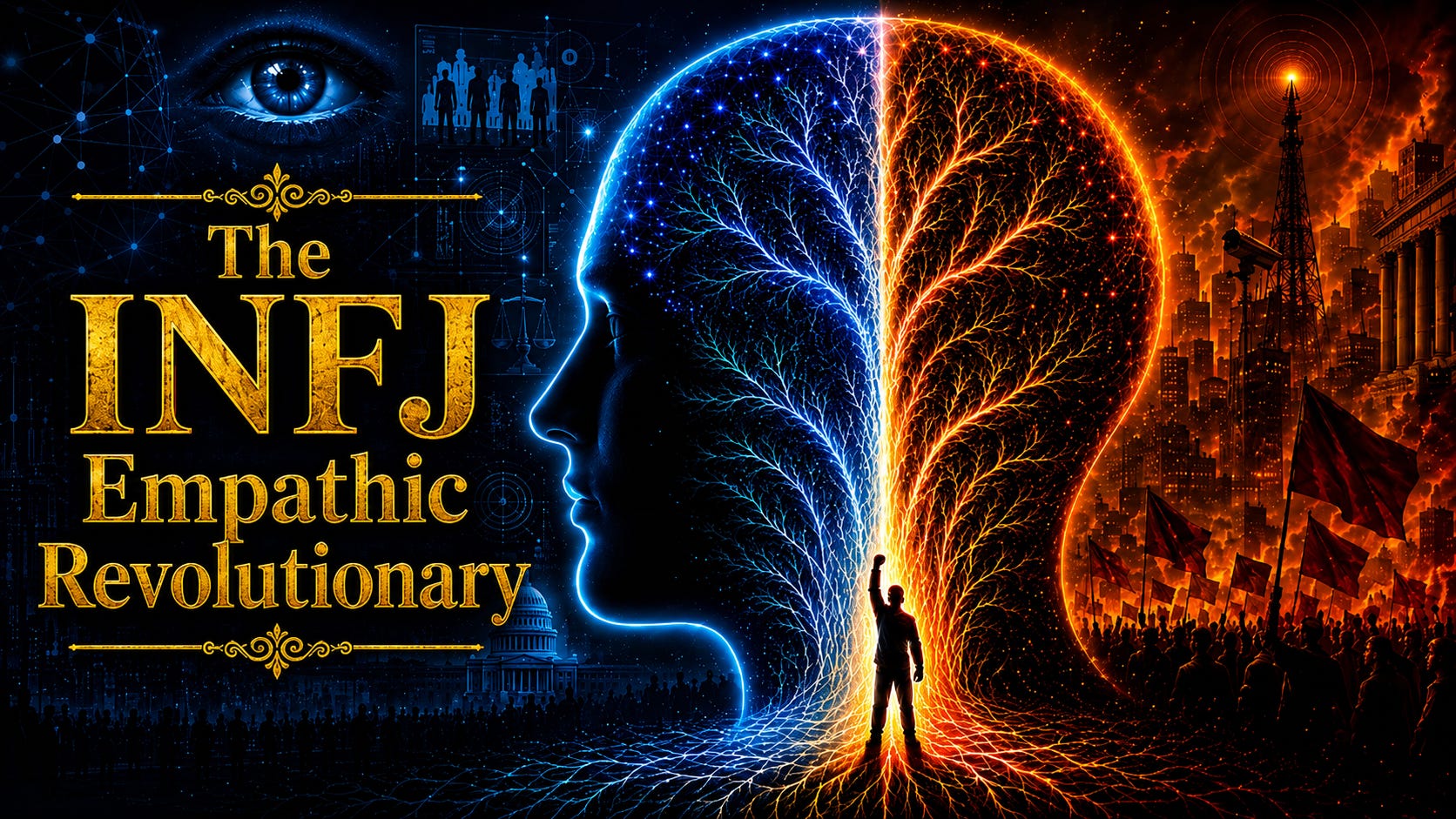
The INFJ Empathic Revolutionary emerges when an INFJ Empath consciously directs their attention beyond the individual and interpersonal dimensions of human experience toward humanity as a whole.
This choice begins with a recognition of what gives their life meaning. Personal success, comfort, and security may be valuable, but they rarely feel complete as ends in themselves. Their deepest fulfillment comes from using their intuition to help others recognize their own self-worth and understand their interconnectedness with others.
Over time, this recognition changes the direction of their life. They begin asking how their insight might serve others on a greater scale. Care for individual people gradually expands into concern for the forces that shape the human condition.
Individual suffering becomes evidence of larger systems. Emotional insight becomes political perception. The sensitivity that once helped them read people now helps them read institutions, propaganda, social behavior, and class power. They begin asking why suffering is reproduced, who benefits from it, and what prevents ordinary people from recognizing their shared struggle.
Empathy becomes a revolutionary orientation. They feel responsible for more than helping individuals survive domination. They become committed to confronting the structures that make domination normal and creating social conditions built around dignity, equality, agency, and collective power.
They remain an INFJ, but the personality is directed toward a larger purpose. Intuition becomes systems thinking. Independence becomes resistance to illegitimate authority. Moral intensity becomes commitment. Empathy becomes solidarity. Private insight becomes strategy.
Core Orientation
At the core of this archetype is a tendency to experience society as a network of relationships, incentives, institutions, stories, and hidden pressures.
When people repeat the same political talking points, they notice the narrative shaping the discussion. When an institution harms people while claiming to protect them, they examine how authority maintains legitimacy. When widespread private doubt remains publicly invisible, they recognize how fear and false consensus prevent ordinary people from becoming a coherent political force.
This pattern-based perception is paired with a strong emotional register. They notice changes in tone, hesitation, forced enthusiasm, unresolved tension, and the distance between what someone says and what their behavior suggests. Their insight can seem uncanny, but it usually comes from close observation, accumulated experience, and the ability to connect subtle signals quickly.
Their intuition can be highly perceptive without being infallible. They treat impressions as working hypotheses and test them against evidence, recognizing that emotional conviction can create false certainty and turn partial information into elaborate conclusions.
Disciplined Perception
Disciplined perception begins with close observation. They often understand the emotional structure of a room before deciding how to participate.
Their perception extends from individuals to systems. They recognize manipulation within a relationship, conformity within a community, and propaganda within a society as related dynamics operating at different scales. In each case, power depends partly on controlling what people believe is normal, legitimate, possible, and socially safe to say.
Because they recognize these patterns, they are difficult to control through ordinary social pressure. Popularity does not establish truth. Authority does not establish legitimacy. Tradition does not establish morality. They compare every demand against their own judgment and values.
Solitude and Clarity
Solitude gives them enough distance from other people’s expectations to identify what they actually think.
They can be warm, attentive, and socially capable, especially in meaningful one-to-one conversations. Yet prolonged exposure to group emotion, shallow interaction, or constant demands leaves them mentally crowded. They withdraw to process what they have absorbed and restore the boundary between their own feelings and everyone else’s.
Their lone-wolf quality comes from self-direction more than isolation. They prefer to choose their path without negotiating every step with a group. They can work for years on an idea few people understand, sustained by the conviction that its value does not depend on immediate recognition.
This allows unusual persistence. It also creates risk. Independence can harden into self-containment. They may carry too much alone, decide that explaining their vision is more exhausting than doing everything themselves, and disappear when collaboration becomes emotionally complicated.
Their development depends on recognizing that autonomy and interdependence can coexist. A revolutionary vision confined to one person can never become collective power.
Empathy With Boundaries
Emotionally disciplined empathy remains deeply engaged without becoming self-erasure. It allows another person’s pain, motives, and unmet needs to be understood without absorbing their emotions, excusing harmful behavior, or granting unlimited access to time, attention, and energy.
They listen closely. People may disclose personal experiences because they feel taken seriously rather than managed. They often identify the need beneath the words, whether it is recognition beneath anger, fear beneath control, or grief beneath detachment.
Earlier in life, this sensitivity may lead them to absorb other people’s crises, excuse harmful behavior, or assume responsibility for healing everyone around them. Experience teaches a harder form of empathy. Understanding someone does not require surrendering judgment. Recognizing the source of harmful behavior does not erase its consequences.
Their mature empathy has boundaries. They may assist someone they dislike because the action is right or necessary. They can care about a person’s suffering while refusing the relationship that produced it. They can withhold reassurance when reassurance would reinforce denial.
Their warmth becomes stronger when kindness is guided by judgment rather than the need to appease. Their empathy becomes disciplined by discernment.
Morals Under Pressure
This type has a strong standard of right and wrong. Their morality is built around equal human worth, freedom from domination, and the belief that power must answer to the lives it shapes.
They are cooperative until cooperation demands moral surrender. At that point, their behavior can change abruptly. The accommodating person becomes immovable. The quiet observer speaks with startling directness. The loyal participant leaves.
The underlying pattern is consistent. They tolerate inconvenience, misunderstanding, and personal sacrifice far longer than coercion or betrayal of principle.
They are especially sensitive to hypocrisy in people and institutions that use moral language to conceal exploitation. They can forgive ordinary human imperfection. Deliberate cruelty dressed as virtue provokes a much deeper response.
Their anger is rarely strongest when they are personally insulted. It becomes focused when vulnerable people are treated as disposable, authority demands obedience without responsibility, or preventable suffering is accepted as the price of preserving power.
Anger can become clarity, resolve, and sustained work, but it can also harden into moral absolutism. They may divide the world too quickly between those who understand and those they believe refuse to understand. Their task is to preserve moral force without surrendering intellectual humility.
Power as Responsibility
This personality is skeptical of hierarchy and uncomfortable with power pursued for its own sake. They dream of making domination harder and collective agency possible.
Even so, they often become leaders. Their calm under pressure, long-range thinking, and ability to name what others sense can create trust. People look to them for direction because they provide coherence when a situation feels fragmented.
Their leadership is quiet. They lead through framing, example, moral consistency, and structures that allow others to contribute. They would rather create capable equals than permanent followers.
This produces tension. They may resist formal authority so strongly that they leave a leadership vacuum, then become frustrated when less principled people fill it. Mature leadership requires accepting responsibility without turning it into ownership. It means setting standards, making decisions, sharing power, and building processes that can function without their constant presence.
Their highest expression is architectural leadership. They create conditions under which people can recover judgment, establish shared recognition, and build collective civic capacity. Their aim is a population of equals capable of governing life together.
Relationships and Trust
Warmth and privacy coexist in their relationships. Others may feel deeply understood while knowing surprisingly little about them.
They want intellectual honesty, emotional depth, mutual respect, and enough freedom for each person to remain fully themselves. They prefer a few substantial relationships to a large social circle.
Trust develops slowly because they pay attention to consistency. Words matter, but patterns matter more. They remember how people behave under pressure, around those with less power, and when there is nothing to gain from appearing kind.
Within those relationships, they communicate best when there is something real to examine. Their style is measured, precise, and layered. They listen for the assumption beneath an argument and often respond to that deeper premise. When they finally speak after long observation, their language can carry unusual force. They have already removed what feels unnecessary and found the sentence that names the central contradiction.
Once trust is established, they can be intensely loyal. They invest attention, insight, and practical support. Betrayal therefore changes the relationship at its foundation. When they leave, the separation may appear sudden, though internally it often follows a long period of observation and failed repair.
When a conversation becomes manipulative or circular, silence is a boundary. When concerns go unspoken until detachment becomes final, silence is a wall that denies others a fair chance to understand what is wrong. The same discipline applies to their precision. Under stress, insight can turn cutting — used to expose a person rather than illuminate the problem. Their standard is telling the truth for a constructive purpose, not for the satisfaction of proving they saw through someone.
Purpose Beyond the Self
The INFJ’s sense of purpose grows from the interaction between dominant Introverted Intuition and auxiliary Extraverted Feeling. Introverted Intuition looks beneath visible conflicts for the patterns connecting them and follows those patterns toward their long-term consequences. Extraverted Feeling keeps that perception tied to the lives affected, preserving an awareness of the human cost while searching for grounds of recognition across social divisions.
Tertiary Introverted Thinking gives this purpose intellectual structure. Moral concern alone does not satisfy them. They need to understand which mechanisms reproduce the harm, whether their explanation is internally coherent, and where intervention could change the outcome. Introverted Thinking turns intuition into a framework others can examine, challenge, and develop. Inferior Extraverted Sensing requires that the vision survive contact with present conditions and become practical action.
They seek change because they feel the human cost of the existing order, understand the mechanisms that preserve it, and can imagine forms of life organized around dignity rather than domination. Their task is to make that imagination practical—to help create conditions under which no person’s freedom depends on another person’s submission.
This is where the archetype becomes fully revolutionary. Its aim is to make the shared human struggle visible enough to foster collective identification across political divides. Partisan conflict thrives when identity is organized around opposing in-groups and out-groups, making partisan identity more salient than common interests and shared human vulnerability. Shared recognition can reorder that hierarchy by strengthening a broader identity rooted in common humanity. As that identity gains social and moral force, partisan attachment loses its power to sustain dehumanization, manufactured division, and political fragmentation.
The purpose of the Empathic Revolutionary is not to stand above humanity and lead others toward freedom. It is to stand within humanity and help make freedom collectively possible.
If you’d like to support the publication and unlock the full archive, I’ve added a 50% off first-year option below.
If you have a thought, a question, or a different perspective, I’d genuinely like to hear it. Leave a comment or join the subscriber chat below.


This is Me 🥹🫂💗
Beautifully said ✨💕
A 71 yr old INFJ who appreciates this quiet affirmation for the day to day life in these times. 🙏🏼
And I love that your name is Cassandra. A favorite Greek character.