
Why A Parallel Society Cannot Defeat Systemic Power — How Culture Can Rewrite Power
Breaking narrative cover, forcing self-exposure, fracturing legitimacy.

Why A Parallel Society Cannot Defeat Systemic Power — How Culture Breaks Empire
Breaking narrative cover, forcing self-exposure, fracturing legitimacy.
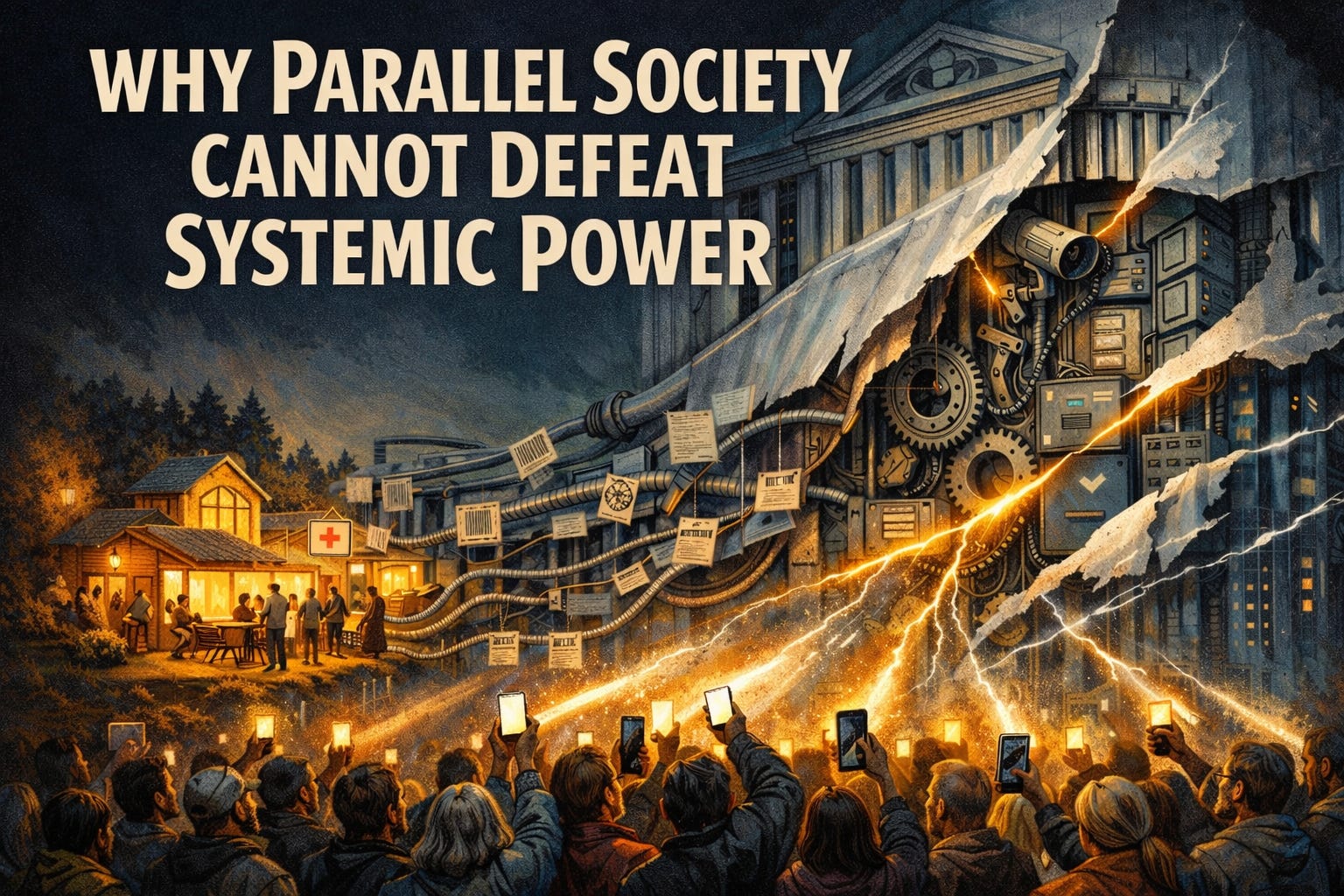
The most common proposal for resisting U.S. Imperial dominance is to build a “parallel society”—a separate way of living outside existing institutions. The idea is intuitively appealing. As a mass population scale strategy, however, it fails.
A parallel society breaks down at scale because it avoids power instead of confronting how power actually operates. Small groups can sometimes lower their exposure by staying low-profile and limiting dependence. A whole population cannot. As participation grows, any parallel system requires land, energy, healthcare, education, finance, transportation, and security. Each of these immediately intersects with the legal, financial, and coercive authority of the existing state and its corporate partners. At that point, the system is no longer parallel. It becomes visible, taxable, regulated, and enforceable.
Empire-level systems are built to detect and absorb alternatives. Regulation, banking controls, surveillance, supply-chain chokepoints, and legal classification exist precisely to block durable exit. Systems that cannot be absorbed are restricted. Systems that cannot be restricted are criminalized. Systems that cannot be criminalized are fragmented or crushed. Any large-scale parallel society must either comply with imperial rules, surrendering independence, or violate them openly, inviting suppression.
Most importantly, parallel-society thinking sidesteps the core issue: legitimacy. Empire persists not because everyone agrees with it, but because its authority is not challenged at the system level. Withdrawal leaves that authority intact. The system can always reassert control during emergencies, shortages, or moments of fear. Hiding reduces short-term risk, but it does not change who sets the rules. Parallel societies therefore function as coping mechanisms, not as population-wide solutions to domination.
Revolutionary Strategy: Culture and Narrative
An explicit legitimacy contest is waged through a truth-driven culture wave that breaks narrative cover and forces self-exposure; the resulting legitimacy fracture is converted into a constituent moment where new rules are authored and secured through UDHR-based constituted power: a binding rights charter and the durable institutions required to administer and enforce it.
The alternative is an explicit legitimacy contest, fought primarily in the cultural and narrative domain. Social media is used to circulate truth-based explanations that strip the existing order of moral and narrative cover. When the system responds, it exposes itself. That legitimacy fracture is then converted into a constituent moment, where new rules can be written, and secured through the rapid construction of new governing institutions.
Key Terms
An explicit legitimacy contest is a sustained effort to challenge a ruling system’s right to govern by changing the conditions under which people comply. The aim is practical: weaken routine cooperation by exposing the gap between official claims and actual behavior, while making repression politically visible and costly.
Constituent power is the claimed authority to write a new foundational settlement. It involves rewriting the rules of the system itself, including rights constraints, enforcement limits, accountability design, and the allocation of power. A constituent moment is the period when this kind of rule-writing becomes possible and broadly recognized as legitimate.
Constituted power is the lock-in layer that makes the new settlement real in everyday life. In this framework, the Universal Declaration of Human Rights (UDHR)—or a comparable civil and political rights charter—serves as the public rights baseline that the new order is bound to follow. Constituted power includes both that binding rights standard and the institutions built to apply it consistently at scale.
Phase 1: Legitimacy Contest Through Cultural Power
The primary battlefield is appearance-based legitimacy: credibility, moral justification, and the ability to frame coercion as protection. The existing order governs most effectively when its actions can be narrated as lawful necessity and public safety.
Social media functions as the distribution layer for factual persuasion. Complex systems are translated into simple, repeatable forms—phrases, visuals, and short explanations—that allow ordinary people to recognize what is happening and explain it to others.
The objective is culture, not debate. Culture sets default language and default interpretation. When large numbers of people can name the mechanism in real time, narrative control stops operating automatically, and official explanations begin to feel strained and artificial.
This creates a dilemma for the incumbent order. Soft responses—denial, ridicule, deflection—allow the critique to spread and normalize. Hard responses—censorship, DE platforming, legal pressure, policing—expose that authority is being maintained through control rather than truth. Both paths accelerate loss of legitimacy when the critique is disciplined and consistent.
As legitimacy erodes, practical effects follow. Allies hesitate. Risks increase for collaborators. Internal dissent becomes safer. Defections grow more likely. Coordination becomes easier as stigma weakens. Traditional activism becomes more effective once legitimacy has already been publicly contested.
Phase 2: Constituent Power
A constituent moment emerges when the existing order can no longer reliably convert its claims into routine compliance, and an alternative rule-writing process becomes credible enough to be taken seriously by large segments of society and key institutions.
Three conditions define this opening.
First, legitimacy rupture. Official justifications lose traction at scale, forcing reliance on visible coercion, emergency measures, or improvised narratives that further damage credibility.
Second, governance instability. Normal administration slows and jams. Rules are applied unevenly. Resistance widens. Institutions delay or refuse cooperation. The cost of governing rises faster than the system can absorb.
Third, recognized authorship capacity. A clear and public process for writing new rules becomes plausible. Credibility comes from transparent procedures, shared standards, and a workable draft framework rather than slogans. At this point, constituent power becomes real and actionable.
Phase 3: UDHR-Based Constituted Power
UDHR-based constituted power is the lock-in layer that turns the new settlement into real, everyday governance. It treats the UDHR (or a similar civil and political rights document) as the public rights floor that the system must obey. The point is straightforward: power becomes legitimate only to the extent that it stays inside those rights constraints.
This phase has two parts.
First is the rights standard itself. The UDHR functions as a shared reference that makes rights legible in public. It establishes a common language for what counts as lawful authority and what counts as domination—especially around core civil and political protections such as equality before the law, fair hearings, freedom of expression, freedom of association, privacy, and protection against arbitrary detention.
Second is the enforcement architecture. A rights document matters only if institutions can apply it reliably. That requires functional systems for administration, dispute resolution, and enforcement under clear constraints. It also requires anti-capture design: transparency, predictable procedures, and accountability that cannot be bypassed through secrecy, emergency framing, or delegated private power.
Speed is structural. A legitimacy fracture creates a limited window. The old order will attempt reassertion through crisis, legal choke points, resource leverage, and fragmentation. UDHR-based constituted power closes that window by giving people and organizations a dependable place to stand: a clear rights baseline and institutions that can enforce it without returning to the prior power architecture.
The empire does not yet exert full control over independent media, and large-scale domination of social media has proven difficult. Its remaining tools are largely limited to purchasing influence and enforcing censorship. At the same time, corporate media has lost much of its former power to shape public opinion.
Independent media must therefore move beyond an excess of political commentary. Commentary without construction sustains reactive outrage rather than building practical capacity. The next phase requires creators to act as builders by developing shared tools, shared frameworks of understanding, and shared norms that can be applied across communities. Constructive work strengthens collective capacity and focuses attention on survival, coherence, and autonomy.
Independent media functions as a strategic lever for long-term change. When truth-based channels earn trust and connect directly to local capacities for resilience, centralized power loses its core instruments of control: confusion, isolation, and scarcity. Efforts to reassert dominance through escalation increase costs and expose the widening gap between institutional narratives and lived reality.
The objective is not simply to outlast the present empire, but to build durable, rights-anchored infrastructure that makes the formation of future empires structurally difficult.
I think the purpose of parallel cultures is to enable resistance to weather the hardships of resisting the major power structures, not to overthrow those structures.
And when the overthrowing occurs we have some pockets of people who have been practicing the forms of social decision-making we otherwise only theorize about.
It seems important to have people around who know how to facilitate councils and dialogue with anarchists.
Dead on.